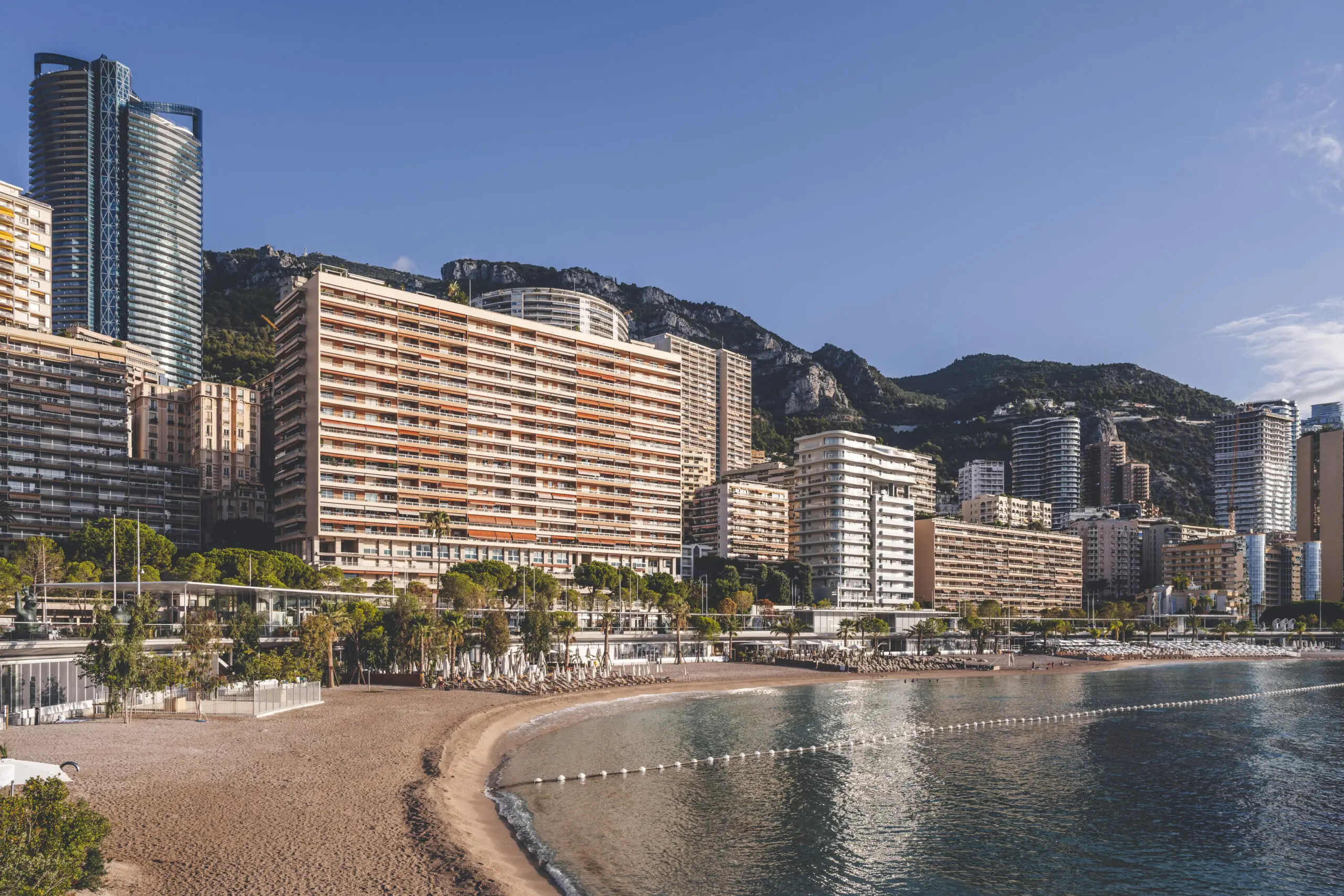
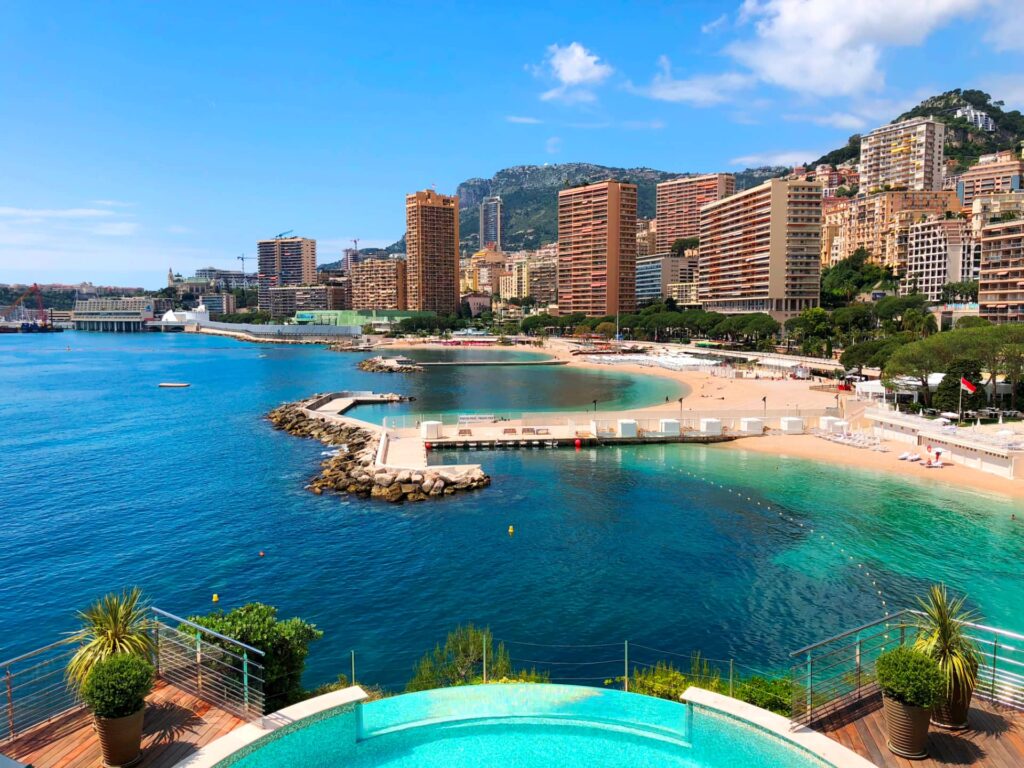
Looking to invest in Monaco real estate — a rare market driven by international demand and structurally limited supply? Here we share concrete benchmarks (prices, districts, taxation, acquisition process, residency) to turn your project into a structured wealth strategy, tailored to the realities of the Carré d’Or, Larvotto or Mareterra.
Why real estate investment in Monaco remains a safe haven
Monaco is a micro-market: limited supply, highly prime assets, and a stable institutional framework. The key is to stay factual: property quality, liquidity, and price consistency relative to the district, residence and amenities.
Key market indicators
- Total area: ~2.08 km² (2.02 km² before Mareterra)
- Estimated average price: €57,569/m² in 2025 (IMSEE, revised series)
- Highest-valued district: Larvotto, €71,167/m² (2025)
- Rental yield: typically around 2% (indicative)
Global demand versus structurally limited supply
Investing in Monaco means accepting a lasting imbalance between demand and supply. Land scarcity, compounded by planning constraints, makes every square metre a highly coveted asset.
The Principality remains one of the world’s most expensive residential markets. The entry threshold is high, and selection often hinges on specifics: address, building, floor, aspect, outdoor space, parking, services and reconfiguration potential.
According to the IMSEE revised series, the average price reached €58,402/m² in 2024 and €57,569/m² in 2025. This reflects an exceptional price level, even with a slight year-on-year inflection.
Individual villas remain the ultimate rarity on the market (extremely limited stock), which explains the particularly high price levels and intense competition for these assets.
Political stability and security as pillars of confidence
Institutional stability and security levels are frequently cited among the reasons for Monaco’s attractiveness, particularly for families and international profiles.
Rather than citing rankings, focus on the essentials: strong police presence, infrastructure and a highly regulated living environment. This context contributes to buyer confidence and the perceived quality of the market.
- Personal security
- Institutional stability
- Quality of life and services
Price analysis and characteristics of Monaco’s districts
Each district has its own logic: property types, buildings, atmosphere and buyer profiles. Succeeding in your Monaco real estate investment requires a fine-grained reading of this geography, beyond a simple average.
Carré d’Or and Larvotto: the pinnacle of ultra-prime
According to IMSEE (2025), Larvotto is the highest-valued district at €71,167/m². Monte-Carlo (which includes the Carré d’Or) is estimated at €54,009/m².
Price benchmarks per m² (IMSEE, 2025)
Larvotto: €71,167/m²
Monte-Carlo: €54,009/m²
At ultra-prime addresses (certain residences and micro-locations in the Carré d’Or or on the seafront), prices can significantly exceed the average and reach exceptional heights, depending on the asset and its amenities.
Fontvieille and La Condamine: residential setting, local life and sustained demand
Fontvieille is estimated at €52,518/m² in 2025. A more residential district, it often appeals through its tranquillity and infrastructure.
La Condamine is estimated at €52,104/m² in 2025. Its appeal lies in its neighbourhood character, shops and central location.
These areas can offer an interesting perspective: prices are high but sometimes more transparent than the ultra-prime segment, with steady rental demand depending on the property type.
Monaco-Ville and Jardin Exotique: rarity, views and distinctive property types
Monaco-Ville features rarer transactions and specific constraints: IMSEE does not systematically publish an estimated price for this district (insufficient data in certain years).
Jardin Exotique is estimated at €45,168/m² in 2025. An elevated district, it combines views with often distinctive property types (volumes, ceiling heights, access).
Moneghetti (€43,797/m² in 2025) also represents a relatively more accessible price point by Monaco standards, while still remaining very high compared to other markets.

Tax and legal framework for acquiring property in the Principality
Beyond the property itself, the tax framework and legal certainty contribute to Monaco’s appeal. Note: exceptions and special cases exist, which is why tailored professional guidance is essential.
No direct taxation for most residents
Monaco does not levy personal income tax on individuals domiciled in the Principality (with specific situations, particularly for certain French nationals). There is also no property tax or council tax.
Inheritance tax is nil in direct line (and between spouses), which represents a significant benchmark in terms of wealth transfer.
For an official source, refer to: Monegasque taxation (MonServicePublic).
The case of French nationals and the tax convention
Note: Franco-Monegasque tax convention
French nationals are subject to specific rules: depending on the circumstances, taxation may still be due in France. A personalised analysis is essential.
The tax convention governs the situation of French nationals. In practice, do not assume any automatic principle: your date of establishment, income and holding structure must be reviewed with a qualified adviser.
A secure acquisition process overseen by notaries
The process typically begins with a written offer. A deposit is frequently requested (often around 10% by convention), but this is not an automatic legal requirement: it depends on the case and conditions.
For certain buildings constructed or completed before 1 September 1947, the State may exercise a right of pre-emption within 30 days of signing the preliminary agreement (if applicable). This can influence the transaction timeline.
For acquisition costs, the standard reference is:
| Type of acquisition | Estimated total fees |
| Resale (individual / Monegasque civil company) | 6.25% (1.5% notary + 4.75% registration) |
| New-build / off-plan (VEFA) | 2.5% |
| Agency fees (standard practice) | 3% + VAT (i.e. 3.6% incl. VAT) |
For a comprehensive overview of the process: guide to buying in Monaco.
Profitability strategies and long-term capital appreciation
In Monaco, the investment rationale is often wealth-driven: balancing personal use, rental income and capital appreciation over time.
The prestige rental market: stability with moderate yields
Rental yields are typically moderate (often around 2% as a rough benchmark). The value also lies in the quality of demand, tenant profile stability and potential asset appreciation depending on the property.
Rigorous management remains crucial to minimise vacancy and secure rental performance:
- Tenant solvency checks
- Thorough property inspections
- Ongoing technical maintenance
The Mareterra effect: a new benchmark
Mareterra (Anse du Portier) is a land reclamation extension of approximately 6 hectares, inaugurated in December 2024. This project is helping to redefine the “new-build ultra-prime” segment.
Prices can reach very high levels on certain units, and the effect on adjacent areas will depend on property types, buildings and market depth.
If referencing a price range, frame it as a “peak observed” rather than an “average”: some reports cite prices potentially reaching ~€120,000/m² on such developments.
Choosing between new-build and the potential of older properties
New-build properties can benefit from lower acquisition costs (2.5%), modern technical standards and services. Older properties may offer reconfiguration and value-add potential, provided the constraints are properly managed (co-ownership, renovation works, permits, timelines).
The decision should remain straightforward: quality of address, quality of property, resale liquidity and price consistency with the actual market.
Settling in Monaco: from residency to bespoke advisory
An acquisition can form part of a broader life project. The residency application relies on administrative criteria and meticulous preparation.
Residency requirements: key benchmarks
To obtain a residence card, you generally need: accommodation (purchase or rental), sufficient financial resources, and a criminal record certificate meeting the application requirements. The application concerns anyone wishing to stay in Monaco for more than three months per year or to establish their residence there.
Regarding the bank certificate: the threshold is not the same for everyone. In practice, a substantial deposit is often required (a frequently cited figure is around €500,000), but this depends on the bank and the applicant’s profile.
For the official framework: applying for a residence card (MonServicePublic).
Here are the documents to prepare (indicative list, to be confirmed based on your situation):
- Proof of accommodation
- Criminal record certificate
- Interview with the Sûreté Publique
Residency conditions (key benchmarks)
- Proof of accommodation (purchase or rental)
- Bank certificate (amount assessed by the bank based on profile)
- Clean criminal record
- Security interview
- Residence card if staying > 3 months/year or residing in the Principality
Access to off-market properties and the wider ecosystem
A portion of the market operates confidentially, depending on the properties and profiles involved. In such cases, network quality, banking preparedness and a clear brief are decisive factors.
Discover Sandro Piras and his expertise. Our objective: to save you time, secure each step and coordinate all stakeholders (banks, notaries, advisers).
In conclusion, investing in Monaco requires a factual approach: asset quality, price, constraints and strategy (personal use / rental / time horizon). If you are ready to move forward, we can frame your project and guide you towards realistic options on the market, whether publicly listed or confidential.
FAQ
Why is Monaco property considered a safe-haven investment?
Because it is a rare micro-market with strong international demand and exceptional price levels. According to the IMSEE revised series, the estimated average price reached €58,402/m² in 2024 and €57,569/m² in 2025. Institutional stability and quality of life further reinforce this perception.
What average prices per square metre should I expect by district?
In 2025 (IMSEE), Larvotto is estimated at €71,167/m², Monte-Carlo at €54,009/m², Fontvieille at €52,518/m², La Condamine at €52,104/m², La Rousse at €51,265/m², Jardin Exotique at €45,168/m² and Moneghetti at €43,797/m². At ultra-prime addresses (Carré d’Or, seafront), levels well above the average may be observed depending on the asset.
How does the property acquisition process work in Monaco?
The process typically begins with a written offer. A deposit is frequently requested depending on the case. The transaction is then secured by the notary (authentic deed, formalities, escrow). Depending on the property, a State right of pre-emption may apply (particularly for certain buildings predating 1947), which can affect the timeline.
What fees and taxes should I budget for?
For a resale (individual or Monegasque civil company), acquisition costs are generally 6.25% (1.5% notary + 4.75% registration). For new-build / off-plan (VEFA), they are typically 2.5%. Agency fees are a separate item (standard practice: 3% + VAT).
What are the conditions for obtaining Monegasque residency through a property purchase?
Purchasing property facilitates proof of accommodation, but does not automatically guarantee residency. The residence card concerns anyone wishing to stay in Monaco for more than three months per year or to establish their residence. The application requires accommodation, sufficient financial resources (bank certificate) and administrative documents (including a criminal record certificate).
What is the specific tax situation for French national investors?
French nationals are subject to specific rules under the Franco-Monegasque tax convention. Depending on the circumstances, taxation may still be due in France. A case-by-case analysis with a qualified tax adviser is strongly recommended.